You kept a food diary for three weeks. You wrote down everything you ate and noted every flare, every foggy afternoon, every bad-gut morning — and at the end you saw nothing. No pattern, no culprit, just two columns that refused to line up. So you gave up, because the data "didn't show anything."
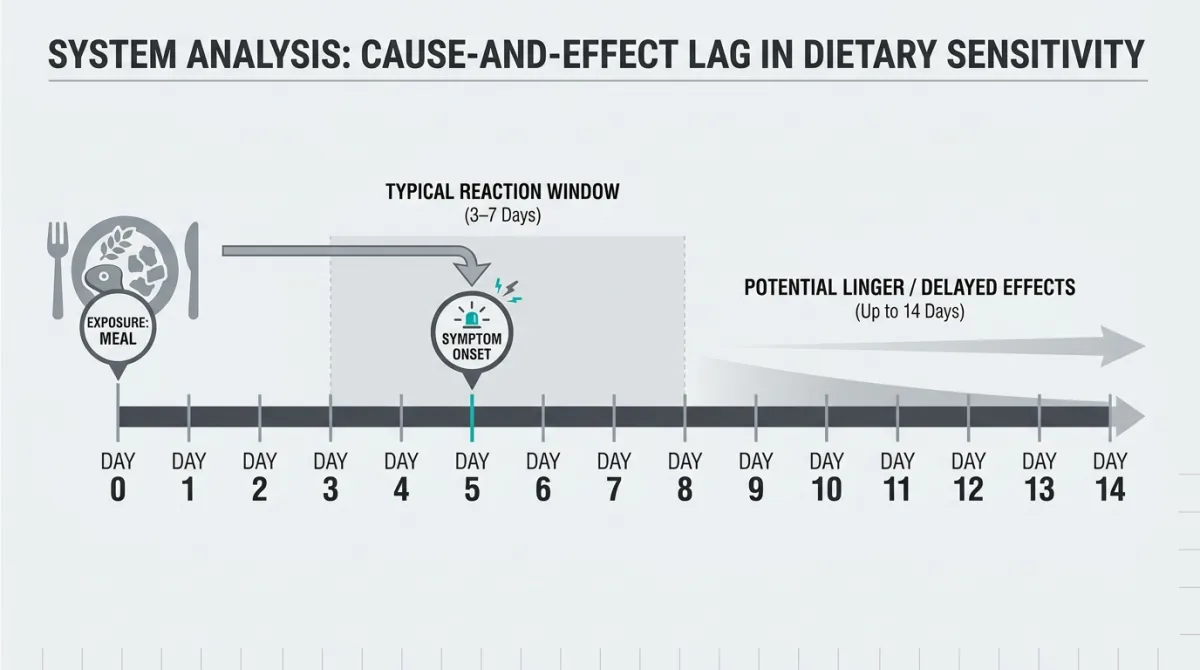
Here's the problem: you were looking on the wrong day. The reaction you felt on Thursday wasn't Thursday's food. It was the cheese you ate on Monday. Delayed food reactions don't arrive on schedule — and they run on two completely different clocks. A single controlled exposure can take anywhere from a few hours up to about 72 hours to surface. But the unknown trigger you eat every day works differently: it compounds quietly over 3 to 7 days before it crosses the threshold where you actually feel it. Most people are in that second case, which is exactly why a same-day food diary fails them.
Plenty of apps will now log your food and flag a correlation for you. Almost none teach you what the lag actually means — how to read it, which clock you're on, and how to tell a real delayed pattern from noise. That interpretation is the whole game, and it's what this piece is about. And this isn't only a human problem: the same delayed-reaction biology shows up in dogs and cats too, which matters if you're tracking your own symptoms and a reactive pet on the same protocol. The surviving edge here — the thing no single-person app does — is delayed-reaction pattern detection across every member of your household, humans and pets, under one carnivore or elimination protocol. The lag is the hidden variable; once you build your log to span it and know how to read it, the invisible pattern becomes obvious. This is how you track it.
Why your food diary "showed nothing" — the lag is the whole problem
A naive food diary makes one silent assumption: that the food and the symptom land on the same page. Eat the thing, feel the thing, write them on the same line. That works fine for a true IgE allergy — peanut at lunch, hives by 2pm. It falls apart for the slow, non-allergic food sensitivities most people are actually trying to untangle.
When the reaction lands two, three, five days later, your eye never connects them. You felt rough on Thursday, so you scrutinise Thursday's meals — and Thursday was a clean day, so you conclude food isn't the issue. Meanwhile the real trigger is four entries up the page, on Monday, looking innocent because nothing happened that day.
That's the trap. The diary didn't fail because the connection wasn't there — it failed because the connection was offset in time, and a tool that only compares same-day rows can't see across the gap. The lag isn't a detail. It's the entire reason this is hard, and the one thing your tracking has to be built around.
Two different clocks: single-exposure vs cumulative reactions
Here's the part almost no food diary explains. Delayed reactions don't run on one timer. They run on two, and which one you're dealing with changes what you're looking for.
Clock one — the single exposure. When you eat a trigger food once — say, during a deliberate reintroduction challenge after a clean elimination period — symptoms from that single hit typically show up within hours to about 72 hours. This is classic Type IV delayed hypersensitivity, an immune response that builds slowly rather than firing instantly, and it characteristically peaks around the 48-to-72-hour mark. So when you reintroduce one food on its own and watch, your window is roughly three days.
Clock two — the cumulative load. This is the one that catches most people, and it's slower. When you eat a trigger food repeatedly — usually daily, because you don't yet know it's a problem — each day's low-grade immune response stacks on the unresolved inflammation from the days before. Think of filling a glass: one day's exposure doesn't overflow it, but keep pouring and eventually it spills. Symptoms typically become noticeable after 3 to 7 days of cumulative exposure, once the load crosses your personal symptom threshold.
If you're reading this mid-protocol and frustrated, you're almost certainly in clock two. You don't know your trigger, so you eat it every day, so it never produces a clean single-day spike — it produces a low rolling hum of symptoms that feels random. It isn't random. It's cumulative.
And there's a tail on both clocks you can't ignore: reactions can keep surfacing up to about two weeks out. That's why you don't get to clear a food after three quiet days — the window is longer than your patience wants it to be.
What the apps that track delayed reactions do — and where they stop
It's worth being honest about the landscape, because it changed in 2026. Delayed food-symptom tracking used to be a gap nobody filled. It isn't anymore — there are now several genuinely good single-person food-symptom trackers, and if you're only tracking yourself, they're worth knowing about:
- Triggerbites correlates food against symptoms across time windows up to about 72 hours, uses fast natural-language logging (you describe a meal the way you'd text a friend and it does the parsing), and targets specific conditions like MCAS and PCOS. It's iOS-only.
- Sensio runs a 48-to-72-hour correlation window, uses AI meal-photo logging so you can snap a plate instead of typing it, has a free tier, and is on both iOS and Android.
- Eatrack leans on AI analysis to surface multi-day patterns from your logged food and symptoms.
Those are real tools doing real work — correlation windows that span the lag, low-friction logging, free entry points. If you are one person tracking one body, any of them can help. Credit where it's due.
Here's where all three stop, and it's the same wall: they track one person. They're built condition-generic for a single human user. None of them track a pet. None of them hold a household — you and your partner and the dog and the cat — on one shared elimination or carnivore protocol, on one timeline, where you can read every member's lag side by side. And none are built around a carnivore or animal-based protocol specifically. That's not a knock on them; it's just a different job. It's the job this piece — and the tracker behind it — is about: delayed-reaction pattern detection across every member of your household, humans and pets, under one carnivore or elimination protocol.
How to structure your log so a delayed reaction is actually attributable
This is the part even the good single-person trackers gloss over. They'll correlate food and symptoms once the data is in. Almost none teach you how to capture the data so a delayed reaction is attributable in the first place — and if your log structure is wrong, no correlation downstream can recover the signal. Three rules make a delayed reaction trackable:
1. Log exposure and symptom-onset as two separate timestamped events. A meal is one event with its own timestamp: Monday 7:10pm, hard cheese. A symptom is a different event with its own: Thursday 9am, flare on left elbow. Don't record the symptom as a property of the day you noticed it — record it as its own dated entry. When both are independent timestamped records, the lag between them becomes a measurable distance instead of a coincidence you have to spot by eye.
2. Get the granularity right. A date alone is usually enough for slow skin or gut symptoms, but for faster-presenting ones — brain fog can arrive in as little as 30 to 90 minutes after a meal — time-of-day matters. Log enough precision that you could later ask "how many hours, or days, separated this exposure from this onset?" and get a real answer. Vague entries ("felt off this week") destroy attribution.
3. Review the look-back window, not the look-at-today. When a symptom appears, the question is never "what did I eat today?" It's "what did I eat across the last 3 to 7 days — and is there anything in the two-week tail behind that?" A log built this way lets you scroll back from an onset and see every candidate exposure inside the lag.
The reason a paper diary loses this is mechanical: reconstructing precise timestamps from memory a week later is unreliable, and the look-back is manual and exhausting, so people stop doing it. A tracker built around exposure-events and onset-events makes the look-back the default view, not a chore.
A note on a popular shortcut: IgG food-sensitivity panels. Frustrated by exactly this problem, a lot of people pay for an IgG blood test hoping it will name their trigger and skip the tracking. It won't. IgG panels are not validated diagnostic tools for delayed food reactions — major allergy and immunology bodies advise against using them to diagnose food sensitivity, because a raised IgG to a food often just reflects ordinary exposure to it, not a reaction. The reliable method is still the unglamorous one: a tracked elimination followed by timed, one-at-a-time reintroduction, with symptom-onsets logged against the clock.
Reading back across the window — what a real delayed-reaction pattern looks like
Once your log captures exposures and onsets as separate timestamped events, reading it is mostly looking backward from each symptom. A genuine delayed-reaction pattern looks like this: a symptom-onset, and then — three, four, five days behind it — the same exposure showing up again and again before flares, while clean stretches trace back to stretches without it. The trigger reveals itself not by sitting next to the symptom, but by consistently preceding it across the lag.
This article is about capturing the lag, not the full art of pattern-reading and deciding when you've got enough data to act. For the deeper walkthrough on what to track day to day and how to read an accumulating dataset, carnivore symptom tracking covers it — so this piece doesn't have to.
The household angle — tracking the lag for everyone (and every pet) on one protocol
Here's where this gets genuinely useful, and where most tools can't follow. The delayed-reaction lag isn't a quirk of human biology — it's the same mechanism in your dog and your cat.
Dogs are a striking example. When a dog is challenged with a trigger food, cutaneous (skin) signs typically take days, not hours, to flare — with a median of about 5 days — and capturing more than 90% of reactors takes a full 14 days of monitoring. (That's canine data specifically, from veterinary food-challenge research; we keep human and animal timings separate.) The shape matches the human cumulative clock — same lag, same two-week tail, same reason a "we switched her food for three days and it didn't help" conclusion is premature.
So if you're managing a household where you're on an elimination protocol and a pet is too, you're tracking two or three sets of delayed reactions on the same clock principle — exactly the case no single-person tool is built for. A human food-correlation app tracks one human. It doesn't track you and your dog and the cat under one protocol, on one timeline, where you can see the whole household's lags side by side. That cross-member view — humans and pets, one carnivore or elimination protocol, one place — is the thing worth building your tracking around. On the canine side, dog elimination diet tracking walks through it, and the human mechanism is the same one explained in how elimination diets work.
Common mistakes that hide a delayed reaction
A few specific habits will bury a delayed reaction no matter how diligently you log:
- Clearing a food after three quiet days. Three good days doesn't exonerate anything — the cumulative clock runs 3 to 7 days, and the tail runs to about 14. Hold your window before you acquit a food.
- Logging symptoms without exposure timestamps. Record "bad skin week" but not when, log meals loosely, and there's no measurable distance between cause and effect. No distance, no attribution.
- Ignoring cumulative load. Looking only for a single dramatic meal that "did it" means you'll miss the food that did nothing on any one day but everything across a week.
- Reintroducing more than one food at a time. Challenge two new foods together and react, and you've learned nothing about which one — and burned a clean window. One food per challenge, then watch the full lag.
- Trusting an IgG panel over tracked observation. The panel isn't validated for this; your timed data is.
Avoid those five and the lag stops working against you.
Let the tool hold the timeline
If you want the look-back to be automatic instead of a weekly act of willpower — exposures and symptom-onsets captured as separate timestamped events, the 3-to-7-day window (and the two-week tail) surfaced for you, across every human and pet in the household on one protocol — that's exactly what Carnivore Tracker is built to do.
Start your free 14-day trial — no credit card required — and see the pattern your diary couldn't.
Frequently Asked Questions
How long after eating a trigger food do symptoms appear?
It depends on which clock you're on. A single exposure — like a one-off reintroduction challenge — typically produces symptoms within hours to about 72 hours, with Type IV delayed reactions peaking around 48 to 72 hours. But an unknown trigger eaten repeatedly (usually daily) is cumulative: symptoms typically become noticeable after 3 to 7 days, once the inflammatory load crosses your threshold, and can keep surfacing up to about two weeks out.
Why didn't my food diary show any pattern?
Almost always because it only compared food and symptoms on the same day. Delayed reactions land days after the meal, so a same-day diary structurally can't connect them. The fix: log each exposure and each symptom-onset as separate timestamped events, then review the 3-to-7-day window behind every symptom rather than just that day's meals.
Can a delayed reaction really take a week to show up?
Yes — for cumulative, daily exposure, 3 to 7 days is the typical window, and reactions can appear up to about 14 days out. That two-week tail is exactly why you shouldn't clear a food after only a few quiet days.
Will an IgG food sensitivity test tell me my triggers?
No. IgG food-sensitivity panels are not validated diagnostic tools for delayed food reactions — a raised IgG to a food often just reflects that you eat it, not that you react to it. The reliable method is a tracked elimination followed by timed, one-at-a-time reintroduction with symptom-onsets logged against the clock.
Does the same delay apply to my dog or cat — and is this the same as a food allergy?
The same delayed-reaction mechanism applies to pets: in dogs specifically, skin signs after a food challenge take a median of about 5 days to flare, with full monitoring around 14 days — so the same "don't clear a food too early" rule holds across the whole household. Note this is not a true IgE food allergy, which is fast, same-day, and (if severe) an emergency — see an allergist for that. This article is about the slower, non-allergic, delayed-and-cumulative food sensitivity pattern.
References
- Caubet JC, Szajewska H. 2018. "Non-IgE-mediated gastrointestinal food allergies in children." Allergy Asthma Clin Immunol. PMC6157279.
- Croall ID et al. 2020. "Brain fog and non-coeliac gluten sensitivity: a cross-sectional study." PLOS One. PMID: 32857796.
- Olivry T, Mueller RS. 2020. "Critically appraised topic on adverse food reactions of companion animals (9): time to flare of cutaneous signs after a dietary challenge." BMC Vet Res, 16:168. PMID: 32448251.
- StatPearls. "Type IV Hypersensitivity Reaction." PMID: 32965899.
- National Institute for Health and Care Excellence. Clinical Guideline CG116. "Food allergy in under 19s: assessment and diagnosis." (1–72 hours for non-IgE reactions.)
- Monash University FODMAP / Department of Gastroenterology. "Symptom threshold and dose dependence in food intolerance."
- British Society for Allergy & Clinical Immunology (BSACI). Guidance on non-IgE-mediated food reactions ("delayed from hours to weeks after ingestion").
Medical disclaimer: This article is for educational purposes only and does not constitute medical advice. Always consult with a qualified healthcare professional before making significant dietary changes, particularly if you are managing a diagnosed medical condition, taking prescribed medication, or have a history of disordered eating. The carnivore or animal-based elimination approach involves significant dietary restriction — appropriate professional supervision is especially important for anyone with a history of nutritional deficiency, kidney disease, or cardiovascular conditions. Symptoms discussed in this article — digestive, skin, cognitive, or joint — can have multiple causes, some of which require specific medical management; tracked elimination is a method for observing your own patterns, not a diagnostic test. If you suspect a true food allergy (especially one causing severe or anaphylactic reactions), seek evaluation from a board-certified allergist. For pet dietary changes, always work alongside a qualified veterinarian.