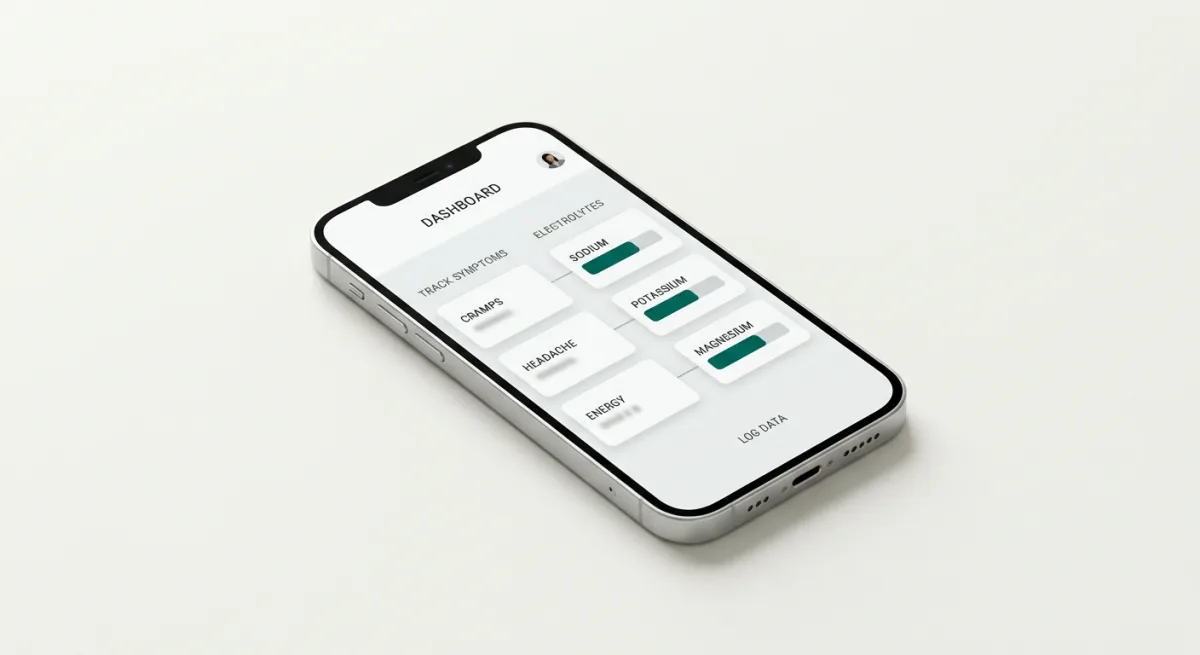
Every electrolyte article on carnivore is selling you a fixed dose. Buy this stick pack. Take this many milligrams. Mix one scoop in water. The advice is identical across the page because the page is an ad.
Your body didn't read the label. On a standard diet, electrolyte balance mostly runs in the background — you eat, you drink, the kidneys handle the rest. Electrolytes carnivore diet practitioners need to think about are different, because the underlying physiology shifts the moment you cut carbohydrates. How much sodium, potassium, and magnesium you actually need depends on how much you sweat, your climate, your activity level, and where you are in adaptation — none of which a one-size product knows. Electrolyte needs on carnivore are real and often higher than people expect, but they're individual. The move isn't to copy a fixed dose; it's to track your symptoms against your intake and dial in your own numbers.
This is the electrolyte deep dive off the broader carnivore tracking methodology, which covers the whole intake-side system. Here we go deep on one variable: electrolytes — why your needs rise, which three to watch, and how to personalise them with a feedback loop instead of a label.
Why electrolyte needs rise on carnivore (and why the first weeks are worst)
When you cut carbohydrates, insulin levels drop. Lower insulin is associated with the kidneys excreting more sodium — a process called natriuresis. As sodium leaves, water follows, and potassium and magnesium balance tends to shift along with it. The leading explanation for the early "carnivore flu" or "keto flu" — cramps, headaches, fatigue, brain fog in the first weeks — is this rapid sodium and fluid loss before your body recalibrates.
A few clarifications, because this gets overstated online. The insulin-to-sodium-excretion link is well described in low-carbohydrate physiology, but the exact magnitude varies person to person — this is a mechanism, not a fixed formula. And the effect is most pronounced early, which is why the first few weeks tend to be the worst. As your body adapts, the acute losses ease.
If you're in that early window specifically, the symptoms overlap heavily with normal adaptation. The transition phase has its own dynamics worth understanding — see the keto-to-carnivore transition window for what's happening as your body switches fuel sources. This article isn't about the transition; it's about treating electrolytes as a variable you track and tune, whether you're on day 10 or day 300.
The three electrolytes to track (sodium, potassium, magnesium)
Three electrolytes do most of the work on carnivore. Here's what each does, what running low tends to feel like, and where it shows up in a meat-based diet.
Sodium. The one most affected by the insulin-driven loss above. Running low is commonly associated with headaches, fatigue, light-headedness when you stand up, and muscle cramps. On carnivore, sodium is the easiest to influence because it's mostly what you add — unprocessed meat is relatively low in sodium, so the salt on your plate is largely the salt you put there.
Potassium. Important for muscle and nerve function. Low potassium is commonly associated with muscle cramps, weakness, and — at the more significant end — heart palpitations. Meat is actually a reasonable potassium source (beef, fish, and pork all contribute), so many practitioners get more from food than they assume.
Magnesium. Involved in hundreds of enzyme reactions, including muscle relaxation and sleep. Low magnesium is commonly associated with cramps (especially at night), poor sleep, and irritability. It's the one most likely to be genuinely low even on a meat-heavy diet, because meat is a moderate rather than rich source.
A note on numbers: general intake reference ranges for these electrolytes are published by bodies like the NIH Office of Dietary Supplements, and those are a reasonable orientation for general needs. But they're population references, not a carnivore prescription, and your individual requirement varies with sweat, climate, and activity. Treat any specific figure as a range to orient around and a starting point to track against — not a target to hit blindly. And see the cardiac/renal caution below before adding potassium or large amounts of sodium if you have any heart or kidney condition.
How to track symptoms against intake (the personalise loop)
This is the part the supplement listicles can't sell you, because it doesn't come in a tub. The way you find your electrolyte needs is a feedback loop:
- Pick the three symptoms that respond fastest — cramps, headaches, and energy/brain fog. These are your output signals.
- Log them daily against your electrolyte intake — what you added, not what an app estimated, since carnivore intake is unprocessed and app estimates assume packaged foods. Pair the intake log with logging your symptoms alongside it.
- Adjust one electrolyte at a time over a short window. Cramping at night? Try nudging magnesium. Headachy and light-headed? Sodium is the usual first suspect (within the cardiac/renal caution below).
- Re-observe over 1-2 weeks. A single day is noise; you're looking for whether the symptom pattern shifts across days.
- Repeat until the symptoms settle, then hold.
Changing one variable at a time is what makes this work. If you add sodium, potassium, and magnesium all at once and the cramps stop, you've learned nothing about which one you actually needed. Move one lever, watch, then decide.
Electrolytes are one of two main "adjust-over-time" variables on carnivore. The other is your fat-to-protein ratio — the same track-adjust-re-observe loop, applied to a different number.
Tracking cramps and headaches against your intake is exactly the feedback loop a carnivore tracker is built for. Stop guessing which stick pack to buy and find your own numbers — see what we made.
Why fixed-dose advice fails (and the cardiac/renal exception that matters)
Fixed-dose electrolyte advice fails for a simple reason: it ignores the variables that actually drive your needs. Two people on identical carnivore diets can have very different requirements — one trains hard in a hot climate and sweats out sodium all day; the other sits in air conditioning and barely sweats. A single product dose can leave the first person short and overshoot the second. The personalise loop above exists precisely because the right number is yours, not a brand's.
But there is one exception where "just track and tune" is the wrong advice, and it's important enough to state plainly:
If you have a heart condition or kidney (renal) disease, do not start supplementing electrolytes — especially potassium, and significant added sodium — without talking to your doctor first. For people with impaired kidney function or certain cardiac conditions, the kidneys may not clear extra potassium normally, and loading it can be genuinely dangerous (it can affect heart rhythm). Added sodium also needs medical guidance for people managing heart failure, high blood pressure, or kidney disease. The same goes for anyone on medications that affect electrolyte balance — including certain blood-pressure medications, diuretics ("water pills"), and others. This is the one place in this article where the right next step is a clinician, not a tracker.
That caution isn't a disclaimer formality. Potassium loading in the wrong context is one of the few electrolyte mistakes that can actually be serious, so it belongs in the body of the article, not buried at the bottom. If that's you, get cleared by your doctor first; then the tracking approach still applies — just within the limits they set.
What "dialled in" looks like — and when to stop adjusting
You don't tune electrolytes forever. There's a steady state, and recognising it is the point of all the logging.
"Dialled in" looks like this: across a 14- to 30-day window, the symptoms you were chasing — cramps, headaches, energy dips — have settled and stayed settled, without you changing your intake. When you can look back over two to four weeks and the output signals are quiet at a consistent intake, you've found your range. Stop adjusting and just maintain it.
A worked example — sodium, headaches, and a 7-day re-evaluation
Here's what the loop tends to look like in practice. The numbers are illustrative, not a prescription — your own logs will give you your own.
Say you're three weeks into carnivore and you've been getting a dull headache most afternoons, around 3pm. You're logging the three output signals and noting what you added for electrolytes each day. A glance back at the last seven days: headaches on 5 of 7 days, added sodium hovering around ~3g/day (the salt on your steak, no deliberate top-up).
Sodium is the usual first suspect when the symptom is "headachy and a bit flat in the afternoon," and you've cleared the cardiac/renal caution with your doctor. You adjust one variable: nudge added sodium to roughly 5g/day, split across meals. Potassium and magnesium intake stay exactly where they were — changing two things at once would tell you nothing.
Re-observe for seven days. By day 4 the headache is milder; by day 6 it's gone two days running; by day 7 your log shows headaches on 1 of 7 days. That's a signal — not proof — that sodium was the lever. Hold the new intake, keep logging, and check again at the two-week mark to confirm it stuck rather than coinciding with, say, a quieter work week.
If by day 7 nothing had shifted, the lever was probably wrong. Revert sodium to baseline, give it a few days to wash out, and try a different variable — magnesium, perhaps, given the afternoon-fatigue overlap. One variable, short window, real signal before you decide it worked.
Week 1-3 vs week 4+ — when the cadence shifts
The tracking cadence isn't the same forever. Early on you're looking for fast feedback in a moving system; later you're looking for drift in a settled one.
Week 1-3 (the adaptation window, if it applies to you) — daily logging. Symptoms are noisiest and your needs are most likely shifting underneath you. Log all three output signals and your added electrolytes daily. Make one adjustment at a time, re-observe over 5-7 days. This is the window where the loop earns its keep — you're actively searching for your range.
Week 4+ (once symptoms have settled at a consistent intake) — weekly check-ins. Once "dialled in" has held for two to four weeks, the cost-benefit on daily logging falls off. The system has stabilised; you want to catch drift, not noise. A weekly check-in works well: a brief end-of-week note on whether the three signals were quiet or notable, and whether anything changed (training load, weather, travel, illness). Quiet week confirms you're still in range. A flare is the prompt to switch back to daily logging for a short window and re-tune.
What NOT to track
Equally useful: knowing what to leave alone. Tracking everything is the fastest way to give up on tracking.
- Don't chase a fixed milligram target for any electrolyte. The listicle numbers are population orientation, not your target. Your number is whatever leaves the three signals quiet.
- Don't log every individual food. Log the added electrolytes — the salt you added, the magnesium you supplemented, any electrolyte mix. Trying to estimate sodium in a ribeye to two decimal places is inaccurate and a fast track to burnout.
- Don't re-adjust after a single bad day. One off day is almost always noise (slept badly, trained harder, hot weather). The loop runs on patterns across days, not single readings.
- Don't change electrolytes and other variables in the same week. If you bump magnesium and shift meal timing and try a new protein source, you've learned nothing about which change did what.
The signal to start tuning again is when the output symptoms return — often after a change in activity, season, or how much you're sweating. That's not a failure; it's the loop doing its job. Your needs shifted, the symptoms told you, and you re-tune. The whole value of tracking is that you catch the shift early instead of three weeks into feeling terrible. For the full intake methodology this sits inside, see how to track the carnivore diet, and a comparison of carnivore tracking apps if you're still choosing a tool.
Start tracking your electrolytes
Electrolyte needs on carnivore are real, often higher than you expect, and entirely individual. The fix isn't a fixed-dose product — it's a feedback loop: track your symptoms against your intake, adjust one variable at a time, and find your own numbers. A tracker built for carnivore lets you pair cramps, headaches, and energy against what you actually took, so you can dial it in instead of guessing.
Start your free 14-day trial — no credit card required — and start tracking your symptoms against your intake.
Frequently Asked Questions
Do I really need electrolytes on carnivore if I'm eating enough meat?
Often, yes — at least early on. The reason electrolytes carnivore diet practitioners pay attention to them is that cutting carbs lowers insulin, which is associated with the kidneys excreting more sodium, and potassium and magnesium tend to shift with it. Meat supplies useful potassium and some magnesium, but sodium in particular is mostly what you add, since unprocessed cuts are relatively low in it. Whether you need to supplement, and how much, is individual — track your symptoms and find out.
How much sodium, potassium, and magnesium should I take on carnivore?
There's no single carnivore-specific number. General reference ranges exist (the NIH Office of Dietary Supplements publishes them), but your individual need varies with sweat, climate, and activity. Use those ranges to orient, then personalise by tracking. Important: if you have any heart or kidney condition, or take medications that affect electrolytes, talk to your doctor before supplementing — especially potassium.
How long does carnivore flu last?
For most people the worst of it is in the first one to two weeks, easing as the body adapts — though it varies. Much of it overlaps with the broader adaptation window; see the keto-to-carnivore transition for what's happening as your body switches fuel sources.
Can I get all my electrolytes from food on carnivore?
Sometimes, particularly for potassium, which meat supplies reasonably well. Sodium usually needs to be added deliberately, and magnesium is the one most likely to run low on meat alone. Rather than assume either way, track your symptoms against your intake and let the pattern tell you where you actually sit.
References
- Tiwari S, Riazi S, Ecelbarger CA. 2007. "Insulin's impact on renal sodium transport and blood pressure in health, obesity, and diabetes." Am J Physiol Renal Physiol, 293(4):F974-984. PMID: 17686957.
- Volek JS, Phinney SD, et al. 2008. "Carbohydrate restriction has a more favorable impact on the metabolic syndrome than a low fat diet." Lipids, 44(4):297-309. PMID: 19082851.
- National Institutes of Health, Office of Dietary Supplements. "Magnesium — Fact Sheet for Health Professionals." (Reference intakes and deficiency context for magnesium; companion sheets for sodium and potassium.)
- MedlinePlus, U.S. National Library of Medicine. "Hyperkalemia (High Potassium)." (Clinical context for the cardiac/renal contraindication on potassium loading.)
Medical disclaimer: This article is for educational purposes only and does not constitute medical advice. Always consult with a qualified healthcare professional before making significant dietary changes, particularly if you are managing a diagnosed medical condition, taking prescribed medication, or have a history of disordered eating. The carnivore or animal-based elimination approach involves significant dietary restriction — appropriate professional supervision is especially important for anyone with a history of nutritional deficiency, kidney disease, or cardiovascular conditions. Electrolyte supplementation — particularly potassium and added sodium — can be unsafe for people with heart or kidney conditions or those on medications affecting electrolyte balance; consult your doctor before supplementing. Symptoms discussed in this article can have multiple causes, some of which require specific medical management. If you suspect a true food allergy (especially one causing severe or anaphylactic reactions), seek evaluation from a board-certified allergist. For pet dietary changes, always work alongside a qualified veterinarian.