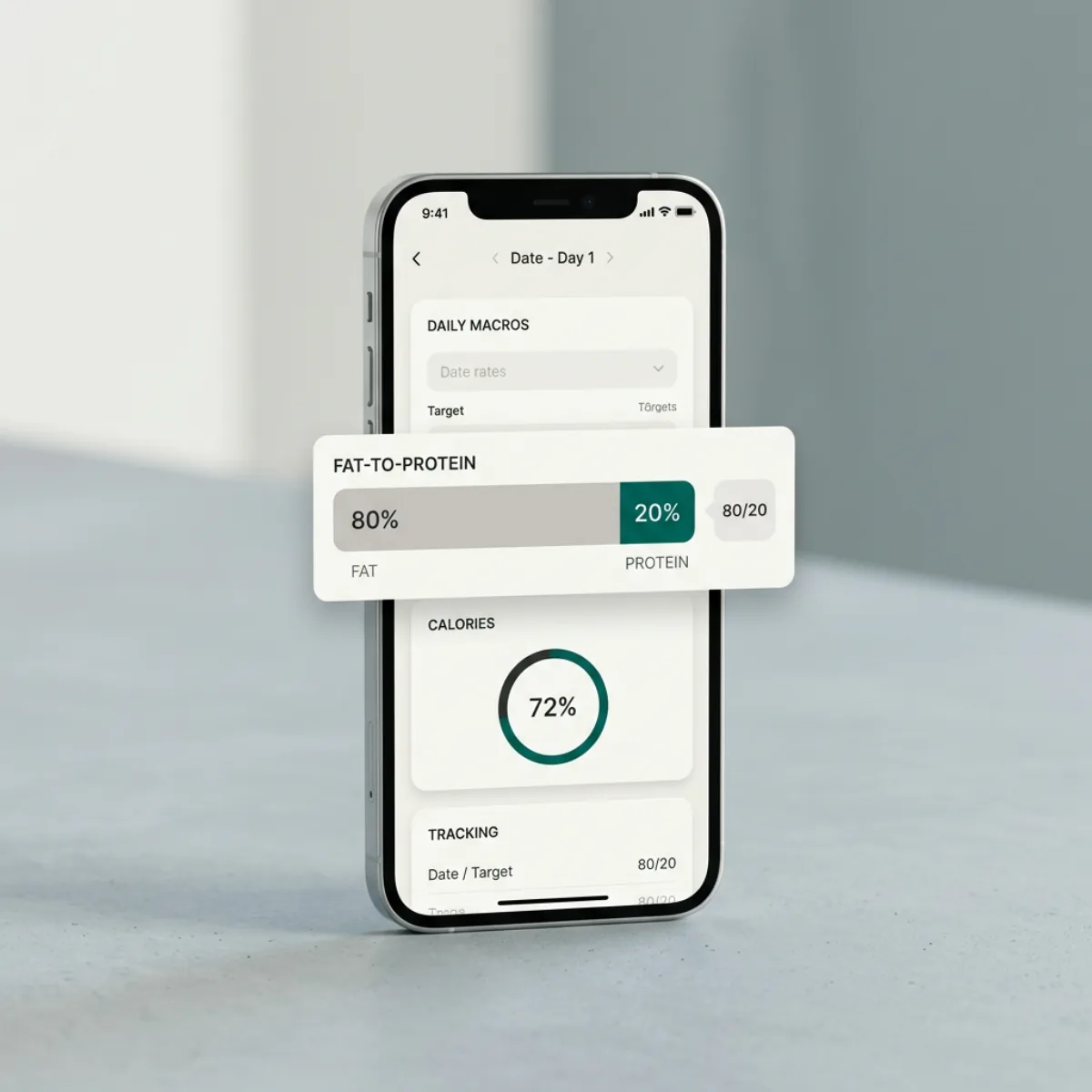
Everyone quotes a ratio. "70/30." "80/20." "Two grams of fat per gram of protein." Almost no one tells you whether that number is by grams or by calories — and the two mean completely different plates. Worse, almost no one tells you what to do when the number you copied from a forum isn't working.
That gap is the whole problem. A static ratio you copy from someone else is a starting guess, not a prescription. Your fat-to-protein ratio is a number you calculate from your own food, then watch and tune over weeks as your body adapts.
This article does three things: clears up the grams-versus-calories confusion, walks you through calculating your own ratio step by step, and — the part nobody covers — shows you how to adjust it as your body responds. It's a deep dive off the broader carnivore tracking methodology, which covers the full intake-side system. Here we go deep on one metric: the ratio.
What the fat-to-protein ratio actually means (grams vs calories)
Here's the confusion that wrecks most ratio conversations: "80/20" by grams and "80/20" by calories describe almost opposite plates.
Fat and protein carry different amounts of energy per gram. Fat provides about 9 calories per gram; protein provides about 4 calories per gram (standard Atwater conversion factors used in nutrition labelling). Because fat is more than twice as energy-dense, a small number of fat grams contributes a large share of calories.
Walk through it. Say you eat 100g of protein and 100g of fat in a day. By grams, that's a 50/50 split — equal weights. But by calories:
- Protein: 100g × 4 = 400 calories
- Fat: 100g × 9 = 900 calories
- Total: 1,300 calories
By calories, fat is 900 / 1,300 = about 69% of energy. The same plate is "50/50 by grams" and "roughly 70/30 by calories." Neither number is wrong — they're answering different questions.
This matters because the ratios people quote online almost never specify which one they mean. When someone says "aim for 70% fat," they almost always mean by calories. When someone says "two-to-one fat to protein," they usually mean by grams. If you don't know which convention a number uses, you can't act on it. This is also why MyFitnessPal can't compute this cleanly — its framework is built around carb counts and macro percentages against a calorie target, not a fat-to-protein relationship on a single-food-group diet.
The fix is simple: always state your ratio with its unit attached. "1.5:1 by grams." "70% of calories from fat." Once the unit travels with the number, the confusion disappears.
How to calculate your ratio (step by step)
You can calculate your ratio two ways. Both are useful; pick the one that matches the number you're trying to compare against.
Step 1 — Log a typical day's fat and protein in grams. Use your actual food, not a guess. A representative day might look like:
- 250g ribeye → roughly 50g protein, 50g fat
- 3 eggs → roughly 18g protein, 15g fat
- 30g butter → roughly 0g protein, 24g fat
- 150g beef mince (80/20) → roughly 30g protein, 30g fat
Totals: 98g protein, 119g fat. (These are rounded estimates from standard food databases — use the values your tracker returns for the specific cuts you eat.)
Step 2 — Calculate the ratio by grams. Divide fat grams by protein grams:
119g fat ÷ 98g protein = 1.2 : 1 by grams (about 1.2g of fat for every 1g of protein).
Step 3 — Calculate the ratio by calories. Convert each to calories first, then take fat as a share of the total:
- Fat: 119g × 9 = 1,071 calories
- Protein: 98g × 4 = 392 calories
- Total from fat and protein: 1,463 calories
- Fat share: 1,071 ÷ 1,463 = about 73% of calories from fat.
So this day is "1.2:1 by grams" and "73% fat by calories." Same food, two legitimate numbers. Write down both the first time so you know how they map for your typical eating.
Step 4 — Repeat across a few representative days. A single day is noise. Three to five logged days give you a real baseline you can trust and, later, adjust against.
Common community ranges — and why there's no single "correct" ratio
There is no peer-reviewed, carnivore-specific standard for the fat-to-protein ratio. What exists is community practice — ranges that many practitioners settle into, not a clinically validated target.
In community terms, many carnivore practitioners aim for roughly 65-80% of calories from fat, which lands somewhere around 1:1 to 2:1 fat-to-protein by grams for most people. The popular "80/20" and "70/30" shorthand usually refers to calories, not grams. These are reported community ranges, not prescriptions — your own number depends on your goals, activity, and how you feel.
Named practitioner frameworks (the ratio guidance you'll see from figures like Saladino, Baker, or Berry) are useful starting heuristics, but they are community-derived rules of thumb, not authoritative science. Treat them as someone else's starting point, not your answer. Where strict carnivore and a slightly broader animal-based vs strict carnivore approach diverge, the "right" ratio shifts too — which is exactly why a fixed number copied from anyone else is only ever a place to begin.
The honest summary: there's a sensible range, the range is wide, and the only way to find your spot in it is to calculate where you currently sit and then adjust.
How to adjust your ratio as your body responds (the part nobody covers)
This is the part the macro calculators skip. Calculating a static ratio is easy. Knowing whether it's the right ratio for you — and changing it when it isn't — is the actual skill. It's also where tracking earns its place.
The loop is simple and repeatable:
- Set a starting ratio from your baseline calculation (Steps 1-4 above) or a community range.
- Log the ratio alongside how you feel over a 1-2 week window — energy, satiety, and GI comfort are the three signals that respond fastest. The intake log holds your fat and protein grams; pair it with the output side by logging how you feel alongside it.
- Read the signal. Persistently hungry an hour after eating, low energy, or "carnivore isn't filling me up"? That often points to too little fat for your needs. Heavy, sluggish, or struggling with GI tolerance? That can point to more fat than you currently handle well.
- Adjust one variable — nudge fat up or down by a modest amount (think one tablespoon of added fat, or swapping a leaner cut for a fattier one), hold protein roughly steady.
- Re-observe over another 1-2 week window, then repeat.
A 1-2 week window matters because your body doesn't respond to a single day. Adaptation is gradual, and one big steak dinner won't tell you anything. You're looking for a trend across days, not a reaction to a meal.
Fat is usually the lever you move, because protein needs tend to be more stable while fat is where energy and satiety get dialled in. The ratio is one of two main "adjust-over-time" variables on carnivore — the other is electrolytes, which deserve their own loop. See the electrolyte side of dialling carnivore in once you've got the ratio moving.
Your ratio isn't a number you set once. It's a starting range you calculate, then tune against your own energy, satiety, and GI response over weeks. Logging the ratio against how you feel is exactly what a carnivore-first tracker is built for — see what we made.
The protein-poisoning rail — why "all lean meat" is the one ratio mistake to avoid
There's one direction the ratio shouldn't drift: too far toward lean protein with not enough fat. This is where "rabbit starvation" comes in — and it's worth understanding precisely, because it gets misreported in both directions.
The anthropological account is the famous part: people subsisting on very lean game like rabbit, with little fat and no other energy source, developed persistent hunger, fatigue, and a drive to overeat protein without ever feeling satisfied (Speth & Spielmann). But the mechanism underneath it isn't folklore. Your gut absorbs amino acids at a finite rate, and your liver clears the resulting nitrogen as urea at a finite rate. Push protein past roughly 35% of total calories and that clearance capacity becomes the binding constraint — Bilsborough & Mann's review of protein upper limits places a practical ceiling nearer 25% of energy, around 2 to 2.5 g per kg of bodyweight per day.
For a modern carnivore practitioner eating ribeye, eggs, and butter, that ceiling is not a realistic everyday danger — fatty cuts keep protein's share of calories comfortably under it. It's the reason the ratio has a floor on fat, not a horror story. The practical takeaway is narrow and useful: don't build your diet on the leanest cuts alone. If your plate is all skinless chicken breast, lean mince, and white fish with no added fat, that's the one configuration the lesson warns against. Keep fat in the picture and the issue doesn't arise.
One exception worth knowing about. That ceiling assumes a healthy liver and healthy kidneys. A small number of people clear nitrogen less well — most notably those with a urea cycle disorder, of which late-onset ornithine transcarbamylase (OTC) deficiency is the most common. It can sit undiagnosed well into adulthood, and an abrupt jump in protein intake is a documented trigger; there are published cases of adults tipped into hyperammonemic encephalopathy after starting a high-protein diet. Reduced liver or kidney function narrows the same margin for the same reason.
This matters here for one specific reason. The early signs — headache, lethargy, confusion, nausea or vomiting, behaviour that's out of character — look almost exactly like the transient "carnivore flu" that everyone tells you to push through. If your symptoms in the first weeks are neurological rather than digestive, don't push through. Stop, and ask a doctor for a blood ammonia level. It's an inexpensive test and the right one to rule this out.
So the rail has two parts. The ratio has a fat floor, and "all lean meat" is the mistake to avoid. And if a protein increase leaves you feeling neurologically off rather than merely adapting, that's a reason to get checked — not a reason to fear getting your ratio slightly wrong.
When your data tells you to change something
Once you've been logging for a few weeks, your ratio data starts telling its own story — and the story is usually about drift, not a single bad day.
Look at your ratio across rolling windows:
- 14-day view: catches short-term drift. A creeping slide toward leaner cuts (fat share falling week over week) often shows up here before you notice it on the plate.
- 30-day view: shows whether a change you made actually stuck. If you bumped fat up two weeks ago, did the average ratio move, or did old habits pull it back?
- 60-day view: shows your true settled baseline — the ratio you actually live at, not the one you intend.
A drifting ratio paired with returning symptoms (energy dipping, hunger creeping back) is the signal to act: recalculate your current baseline, identify which way it's drifted, and make one deliberate adjustment. Then re-observe. The point of logging the number isn't to admire it — it's to catch the drift early and tune before it becomes "carnivore stopped working for me."
For the full intake-tracking methodology that this ratio work sits inside — what else to log, at what cadence, and how the pieces fit — see how to track the carnivore diet.
Frequently Asked Questions
Is the carnivore fat-to-protein ratio by grams or by calories?
It can be either, and they describe very different plates — so always state the unit. Fat carries about 9 calories per gram and protein about 4, so a "50/50 by grams" day is closer to "70/30 by calories." When people quote percentages like "70% fat," they almost always mean by calories; when they quote "2:1," they usually mean by grams. Calculate both for your typical day so you know how they map.
What's a good fat-to-protein ratio to start with?
There's no single correct number. As a community-practice starting range, many carnivore practitioners aim for roughly 65-80% of calories from fat, which is around 1:1 to 2:1 fat-to-protein by grams. Treat that as a place to begin, then adjust based on your energy, satiety, and GI response over a couple of weeks.
Can too much protein really be dangerous on carnivore?
For most people, no — not at the intakes a fatty-cut carnivore diet actually produces. There is a real physiological ceiling: protein above roughly 35% of calories outruns the liver's capacity to clear nitrogen as urea. But eating ribeye, eggs, and butter keeps you well under it, which is simply why the ratio has a floor on fat. The practical lesson is to avoid building your diet on the leanest cuts alone, not to fear getting your ratio slightly off. The exception: people with an undiagnosed urea cycle disorder, or with reduced liver or kidney function, clear nitrogen less well. If a jump in protein leaves you with headaches, confusion, or unusual lethargy rather than ordinary digestive adjustment, stop and ask your doctor for a blood ammonia test.
How often should I recalculate my ratio?
Recalculate your baseline every few weeks, and any time your energy, satiety, or GI comfort shifts. Use 14-, 30-, and 60-day views to spot drift, make one deliberate adjustment, then re-observe over another 1-2 week window before changing anything else.
References
- Bilsborough S, Mann N. 2006. "A review of issues of dietary protein intake in humans." Int J Sport Nutr Exerc Metab, 16(2):129-152. PMID: 16779921.
- Westman EC, Feinman RD, Mavropoulos JC, et al. 2007. "Low-carbohydrate nutrition and metabolism." Am J Clin Nutr, 86(2):276-284. PMID: 17684196.
- Speth JD, Spielmann KA. 1983. "Energy source, protein metabolism, and hunter-gatherer subsistence strategies." Journal of Anthropological Archaeology, 2(1):1-31.
- "Late-onset ornithine transcarbamylase deficiency triggered by an acute increase in protein intake: a review of 10 cases reported in the literature." PMC7197010. ncbi.nlm.nih.gov
- "Adult-onset ornithine transcarbamylase (OTC) deficiency unmasked by the Atkins' diet." Journal of Hepatology. sciencedirect.com
- U.S. Department of Agriculture, Agricultural Research Service. "FoodData Central." (Atwater energy conversion factors: fat ~9 kcal/g, protein ~4 kcal/g.)
Medical disclaimer: This article is for educational purposes only and does not constitute medical advice. Always consult with a qualified healthcare professional before making significant dietary changes, particularly if you are managing a diagnosed medical condition, taking prescribed medication, or have a history of disordered eating. The carnivore or animal-based elimination approach involves significant dietary restriction — appropriate professional supervision is especially important for anyone with a history of nutritional deficiency, kidney disease, or cardiovascular conditions. Symptoms discussed in this article can have multiple causes, some of which require specific medical management. If you suspect a true food allergy (especially one causing severe or anaphylactic reactions), seek evaluation from a board-certified allergist. For pet dietary changes, always work alongside a qualified veterinarian.