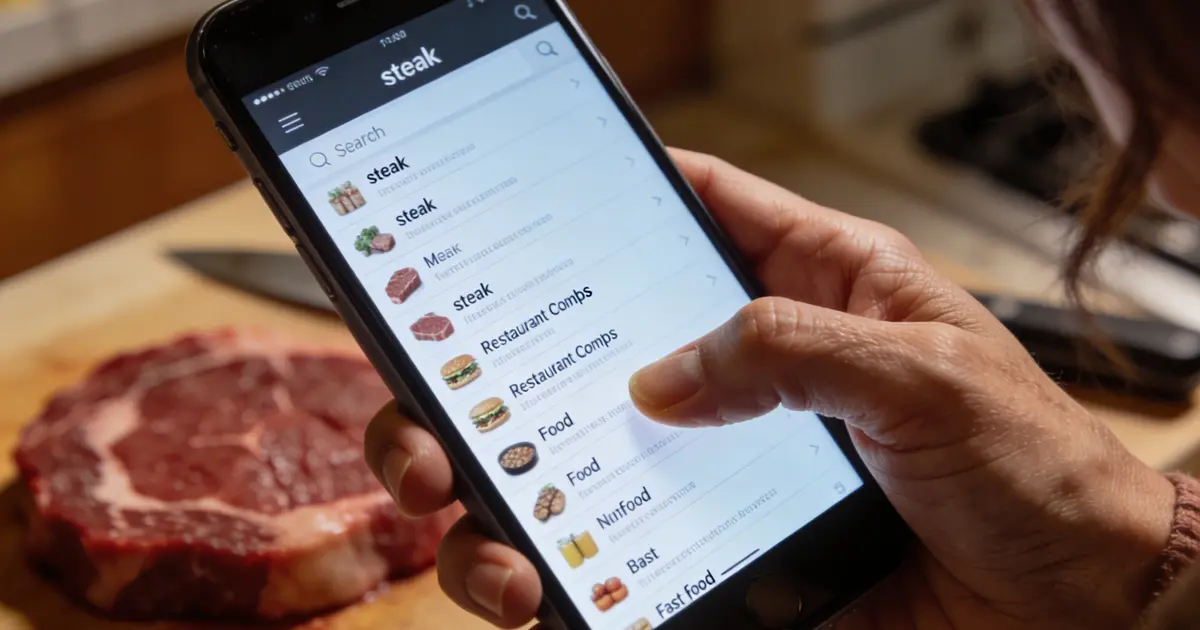
You've tried to make MyFitnessPal work for carnivore. Everyone does, at first — it's the most-downloaded food tracking app in the world, you probably already have an account, and the database genuinely is enormous.
But something keeps feeling off.
You search "ribeye steak" and scroll past ribeye-flavoured crisps, restaurant ribeye with loaded sides, steakhouse combo platters, and a dozen entries you have to inspect one by one to find actual beef. Your macro dashboard has a carbohydrate ring spinning anxiously at zero. The app sends you notifications asking if you've logged your vegetables. The meal suggestions reference foods you haven't eaten in months.
You're not using the wrong app because you're doing something wrong. You're using the wrong app because MyFitnessPal was built for a different diet — and no amount of workaround changes that.
Here's what's actually broken, and what a carnivore-first tracking approach looks like.
The Database Problem
MyFitnessPal's headline feature is its database: over 20 million food entries, a mix of company-verified items and user-contributed entries. For a general-diet tracker, this is genuinely impressive.
For carnivore, it's a problem.
The database is user-generated, which means it's full of duplicates, errors, and entries that don't match what's actually on your plate. Search "ground beef" and you'll find dozens of entries with different macro values for what appears to be the same thing — and no clear way to know which is accurate. Entries for "brisket" range from restaurant braises with sauce baked in to raw lean cuts, all listed under similar names.
More frustrating: the search algorithm surfaces popularity, not relevance. Popular searches in MyFitnessPal's general user base are not ribeye steaks and beef liver. They're salads, protein bars, restaurant meals, and packaged foods. The things you actually eat on carnivore are buried several scrolls down.
What a carnivore-first database looks like: a curated list of animal proteins, cuts, and organs that surfaces immediately when you search. No noise. No scrolling past steak-flavoured crackers. Ribeye loads in seconds. Liver is there. Bone broth is there. You log your meal in under a minute rather than five.
The Macro Framework Problem
MyFitnessPal's macro dashboard was designed around a conventional dietary framework: carbohydrates are tracked prominently as a central category, with fat and protein alongside. Hitting your carb goal is considered progress. Staying under it is the tracking challenge.
On carnivore, your carbohydrate intake is at or near zero. Every day. This isn't a tracking challenge — it's just your diet. But MyFitnessPal's interface is oriented around carbs as the primary variable, which means:
- Your carb ring is perpetually empty in a way that reads as failure rather than intention
- The app may flag low carb intake as nutritionally concerning
- The dashboard emphasis doesn't match what you actually care about: protein-to-fat ratio, overall calories, and potentially electrolyte intake during adaptation
What a carnivore-native dashboard looks like: protein-to-fat ratio front and centre. Calorie total visible. Carbs either hidden or deprioritised because they're irrelevant to your eating pattern. The data you actually care about is the data that greets you when you open the app.
The Symptom Tracking Problem
Here's the gap that matters most — and the one no generic diet app addresses.
Many people who adopt carnivore or animal-based eating do so because of a health condition: persistent skin issues, gut problems, joint pain, brain fog, chronic fatigue, an autoimmune diagnosis. The dietary change isn't just about weight or macros. It's about figuring out which foods are driving which symptoms.
MyFitnessPal tracks food. It does not track symptoms, energy levels, skin condition, joint stiffness, sleep quality, mood, stress levels, or any of the other variables that determine whether your dietary changes are actually working.
More specifically, it has no concept of the delayed reaction window — the fact that for people with food sensitivities, symptoms can appear hours to several days after the trigger food was eaten, not immediately. Without logging symptoms with timestamps alongside your food log, it's impossible to build the dataset that reveals these patterns.
This isn't a feature MyFitnessPal forgot to include. It's simply not what the app was designed for. The product is built for people tracking calories and macros. If you're tracking food to understand your health and identify what's driving your symptoms, you need a different tool for a fundamentally different job.
The Family Problem
MyFitnessPal is built for individual users. One account, one person.
If you're managing your own carnivore elimination alongside tracking a child with food sensitivities, a partner working through their own health investigation, and a dog with recurring skin issues — which is more common than you might think among people in this community — you need separate accounts, separate apps, and no way to view any of it together.
Some carnivore households are tracking multiple people and pets simultaneously: a parent working through an autoimmune elimination protocol, a partner tracking energy and performance, a child with food sensitivities, and one or more pets with skin or gut issues. Any combination. That's a household-level health project, not an individual one. No generic diet app is built for it.
The Privacy Problem
MyFitnessPal has a documented data breach on record that is worth knowing about. In February 2018, an unauthorised party accessed user data affecting approximately 150 million accounts — exposing usernames, email addresses, and hashed passwords. No financial data, payment details, or government identifiers were compromised, and the company disclosed the incident and notified users within weeks of discovering it.
If you're logging detailed health data — symptoms, medications, health conditions, sensitive personal metrics — the privacy posture of the app holding that data still matters. The free tier of MyFitnessPal includes advertising, and as with most freemium apps, the business model involves some relationship between user data and commercial activity.
This isn't unique to MyFitnessPal — most free apps in this space have the same tension. But if health data privacy is important to you, it's worth reading what you're agreeing to.
What a Carnivore-First Tracking Approach Actually Looks Like
The right tool for carnivore tracking — specifically for people using it as a health recovery approach — has a few non-negotiable features:
- Animal-food-first database. Search and find immediately. No scrolling past irrelevant entries. Logging takes under two minutes.
- Protein-to-fat ratio dashboard. The macro that matters for carnivore is the balance between protein and fat, not a carb countdown. The dashboard should reflect how you actually eat.
- Symptom logging alongside food. Every day, alongside meals: energy (1–10), specific symptoms with severity and timing, sleep quality, stress level. These are the data points that, over weeks and months, reveal the food-symptom connections that drive health outcomes.
- Delayed reaction detection. The system needs to surface correlations across a 3–7 day window — connecting what you ate earlier in the week to how you feel today. Manual analysis of this is nearly impossible. AI pattern detection handles it automatically after enough data is accumulated.
- Multi-profile support. One account manages every human and pet in the household — adults, children, dogs — each with their own separate data and tracking. No juggling multiple logins or separate apps.
- Privacy-first architecture. Encrypted. GDPR-compliant. Data never sold. You own your health data.
The Honest Trade-Off
MyFitnessPal does some things extremely well. If you want a massive food database, wearable integrations, calorie tracking across a varied diet, or a social community of millions, it's a strong product. The frustrations carnivores encounter are mostly friction from trying to use a general-diet tool for a specific-diet purpose.
If your goal is:
- Body composition and weight tracking on carnivore — a dedicated macro tracker like Vore will serve you better than MyFitnessPal
- Health condition management, symptom tracking, and food sensitivity investigation through carnivore — you need a symptom-aware tracker like Carnivore Lifestyles
These are different tools for different goals. The question is which one actually matches yours.
Disclaimer: This article references MyFitnessPal and other third-party products for comparison purposes. Features, pricing, and data policies change over time — verify current details directly with each provider. The data breach and privacy information referenced is based on publicly reported events. This article is for informational purposes only and does not constitute medical or nutritional advice.